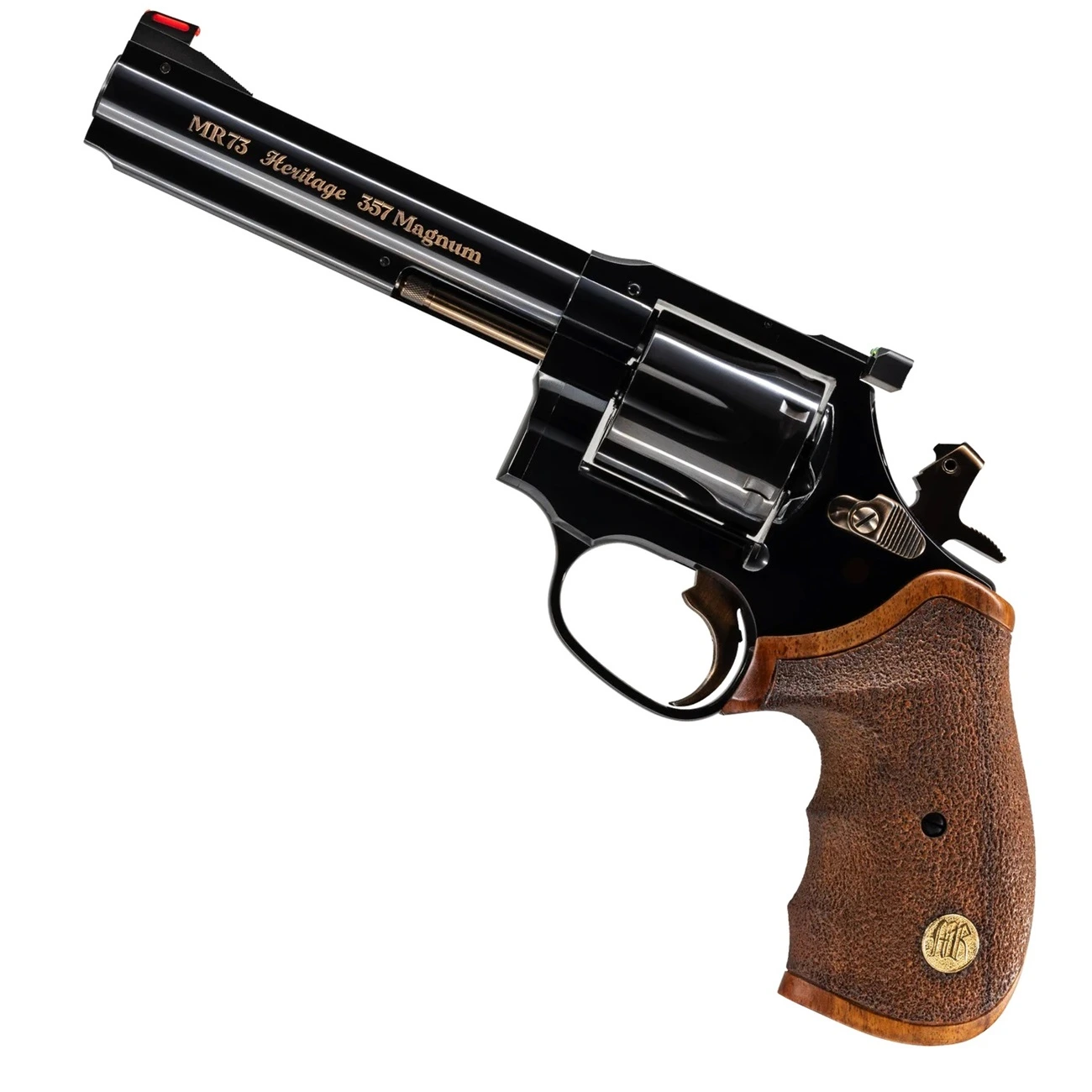
On December 26, 1994, Air France Flight 8969 sat on the tarmac in Marseille with four armed hijackers and well over a hundred hostages aboard, and a French Gendarmerie intervention team was about to end it in roughly twenty minutes. When Chief Warrant Officer Thierry Prungnaud went through that cabin door as the point man, the sidearm in his hand was a Manurhin MR73 — a .357 Magnum revolver built to survive a GIGN training regimen most guns don’t live through: roughly 150 rounds a day, every day, for years, with some issue guns reportedly passing a quarter-million rounds fired before they were retired.
That’s the gun — or at least the direct descendant of it, now built by Chapuis Armes and imported by Beretta USA — that just became available to Californians.
History Before Hardware
The MR73 wasn’t designed as a target gun that happened to find police work. It went the other direction. Manurhin developed it in the early 1970s to arm the National Gendarmerie and French police units, and GIGN, stood up in 1973 and 1974, started out with Smith & Wesson revolvers before moving to the MR73 when those guns couldn’t hold up to its daily training load. The Gendarmerie variant that just cleared California carries that service pedigree directly: adjustable rear sight, taller front sight, and a 4-inch barrel built for duty carry rather than bullseye shooting, though it’ll do both.
What makes the MR73 worth the fuss decades later isn’t nostalgia. Each gun ships from the factory with its own test target fired at 25 meters, and averaged over 15 rounds, no group is allowed to open past 20mm — that’s a rifle-grade accuracy standard out of a service revolver. Every cylinder chamber is proof-fired with loads generating 30 percent more pressure than the C.I.P. maximum for .357 Magnum, and the cylinder is rated to withstand roughly double that maximum. The trigger is adjustable for overtravel, hammer force, and hammer-spring weight, and as far as I can tell from poking around enough gun writers smarter than me on the subject, nobody else has successfully cloned the mechanism even now that the original patents have long since expired. All that polishing and hand-fitting shows up in the price: Beretta lists the 4-inch Gendarmerie starting at $3,799, well north of a comparable Smith & Wesson or Colt wheelgun.
The Part That’s Actually News
Here’s where this stops being a history lesson and becomes a story about California specifically. Every handgun sold at retail in the state has to appear on the California DOJ’s Roster of Handguns Certified for Sale, the list that effectively functions as a permission slip for every new handgun sold there. Getting on it means submitting sample guns for lab firing and drop testing, then paying to keep the model listed. The roster’s most notorious rules — chamber-load indicators, magazine disconnects, and microstamping — are aimed at semi-automatic pistols, not revolvers, so the MR73’s hurdle was mostly economic. Pushing a low-volume, hand-fitted import through that process isn’t something most importers bother attempting; the unit economics rarely justify the cost for a gun that already retails near $4,000.
Beretta clearing that bar for the 4-inch Gendarmerie means California shooters — people who’ve been reading about this revolver’s reputation in gun forums and import write-ups for years without any legal path to actually own one — can now order it through a California dealer like any roster-listed handgun. I am no revolver purist, but even I’ll admit there’s something satisfying about watching a gun built to survive a hostage rescue clear a bureaucratic obstacle course built to keep guns out of civilian hands.
Rocks to Throw
When it comes to rocks to throw, there are two. The first is the same one that’s followed this revolver since Beretta began importing it in 2021: the price. Roughly $3,800 buys you a lot of options in the American market, most of them not hand-fitted to this standard and none of them carrying a service record that includes an actual hostage rescue. That’s not a flaw so much as the cost of admission — Manurhin was never selling a budget gun, and nobody buying one is confused about that. The second is that only the 4-inch Gendarmerie made the roster, so the Sport models and the 3-inch Gendarmerie remain out of reach for California buyers.
Still, at the end of the day, this is a revolver with a genuine claim to the “best in the world” conversation finally reaching the one state market that’s historically been the hardest to crack. For California shooters who’ve wanted one since the first import batch landed stateside, the wait is over.
